Versalit EPI-1
PPE detector for the factory floor: it shows who is wearing a hard hat, who is wearing a safety vest and who is unprotected — in images and video. Open weights under Apache-2.0 and documentation in Portuguese.
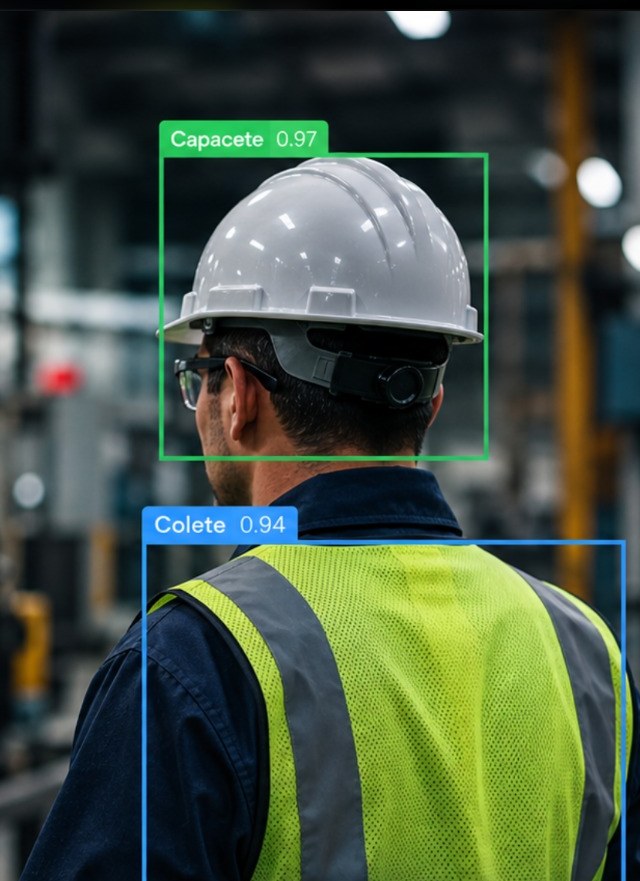
What it does
Point a camera at the floor — or feed it a photo — and EPI-1 returns boxes with one of three answers: hard hat, no hard hat or safety vest (helmet, no_helmet and vest in the model's output). It is the basic visual safety checklist of a plant: whoever walks in without a hard hat shows up in red; whoever is protected, in green.
It was designed for factories, warehouses and production lines — not for US construction sites, where most public PPE detectors were trained.
How it works
Under the hood is RF-DETR, a transformer-based real-time detector released under Apache-2.0. Unlike the most common YOLO detectors, which carry AGPL-3.0, it can ship inside a commercial product without forcing you to open your code.
Each frame is resized to 384 px, normalized and sent to the model. The output is a list of boxes, each with a class and a confidence score. The inference script draws the boxes and, for video, repeats the process frame by frame — you can plug it into the camera the plant already has.
The model comes in two formats: ONNX, to run with onnxruntime on CPU or GPU without the training framework, and PyTorch, to keep training on your own images.
Metrics
| Metric | Value |
|---|---|
| mAP50 | 0.938 |
| mAP50:95 | 0.677 |
| Precision | 0.912 |
| Recall | 0.888 |
How to read it: in ~9 out of 10 detections it gets both the class and the box right (precision), and it finds ~89% of the cases present in the image (recall). The ~11% it misses are usually small people in the background or partially covered. Measured on the validation split — images the model never saw during training.
How it compares
| Model | mAP50 | Precision | Recall | License |
|---|---|---|---|---|
| Hansung-Cho/yolov8-ppe-detection | 0.744 | 0.831 | 0.685 | AGPL-3.0 |
| killuminati1/construction-ppe-yolov8 | ~0.76 | ~0.81 | ~0.72 | AGPL-3.0 |
| Hexmon/vyra-yolo-ppe-detection | not published | — | — | AGPL-3.0 |
| melihuzunoglu/ppe-detection | not published | — | — | AGPL-3.0 |
| Versalit EPI-1 | 0.938 | 0.912 | 0.888 | Apache-2.0 |
Honest comparison: their numbers come from larger, harder datasets (10 to 19 classes, including gloves, boots and masks). EPI-1 has 3 classes — an easier test, a higher number. It does not mean it "won"; it means that on its task, basic factory PPE, it reaches production level with a license that does not lock up your product.
How to run
git clone https://huggingface.co/delvek/versalit-epi-1
cd versalit-epi-1
pip install -r requirements.txt
python infer.py --model epi-1.onnx --input photo.jpg --output result.jpg
Retrain or fine-tune on your photos
python download_dataset.py   # downloads jhboyo/ppe-dataset (15.5k images)
python yolo_to_coco.py       # converts to COCO format
python train.py --size nano --epochs 20
python export_onnx.py        # builds epi-1.onnx
Honest limitations
- It is visual detection: it flags PPE presence in the image, it does not certify regulatory compliance.
- Trained on public construction and industry images — on your floor, with your lighting and your PPE, validate before trusting it; fine-tuning on real photos helps a lot.
- Reliable distance: a person must take up at least ~3% of the frame height.
- It does not detect gloves, boots or goggles — that is what EPI-2 is for.